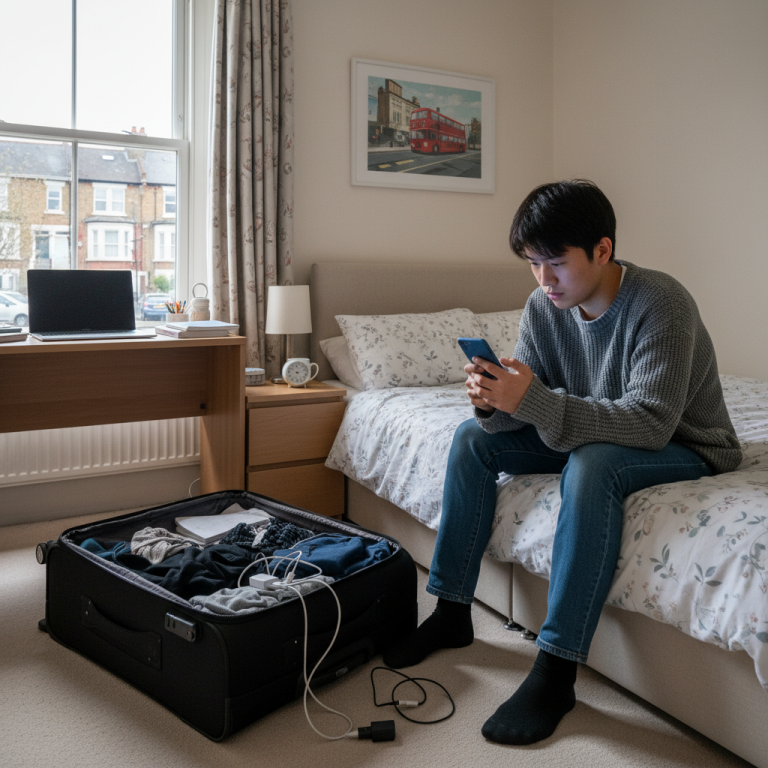


These accounts are drawn from real students who stayed with London host families through our service. Names are used with permission. Some details have been lightly edited for clarity.
The first evening
Gabriela arrived from Brazil on a Tuesday afternoon in October. She’d taken the Tube from Heathrow to Tooting Broadway, dragging a suitcase that was too heavy and a phone with 4% battery. Her host, Margaret, met her at the door, took the suitcase, and put the kettle on.
“I was so tired I could barely speak English. Margaret showed me my room, told me dinner would be ready in an hour, and said I could sleep first if I wanted. I didn’t sleep. I sat in the kitchen and we talked for two hours. By the time I went to bed, London didn’t feel scary any more.”
— Gabriela, Brazil
That first evening sets the tone. Most students arrive tired and nervous, especially if they’ve never been to London before. The difference between walking into a warm kitchen and walking into an empty studio flat is hard to overstate. For more on what a homestay placement actually includes, see our guide to what a homestay is.
The worry about house rules
Before arriving, Tomas from the Czech Republic had spent weeks reading forums about homestay house rules. He expected curfews, restrictions on using the kitchen, and awkward confrontations about noise.
“I thought there would be strict rules about everything. Actually, my host just asked me to let her know if I’d be missing dinner. That was basically it. I had my own key, came and went as I pleased. It felt more like staying with a relative than following a rulebook.”
— Tomas, Czech Republic
This comes up repeatedly. Students expect rigid house rules and find something much more relaxed. Adult students have their own keys. There’s no curfew. The main expectation is communication — letting your host know about meals, being considerate about noise late at night, the same things you’d do living with anyone. The “rules” provide clarity rather than restriction.
Dinner
If there’s one moment that defines the homestay experience, it’s dinner. It’s where the real English practice happens, not grammar exercises, but actual conversation about your day, the news, what’s on television, whether it’s going to rain tomorrow (it probably is).
“My host cooked incredible food. Roast dinners on Sundays, curries during the week, always something different. But the food wasn’t really the point. It was sitting at the table and talking. My English improved more at dinner than in any classroom.”
— Mackenzie, Canada
Hana from Japan said something similar: “In Japan, I studied English grammar for years. In my homestay, I learned how English actually sounds when real people speak it. The idioms, the humour, the way British people say ‘sorry’ when they mean twelve different things.”
The dinner table is where students stop translating in their heads and start thinking in English. It’s unstructured, unpressured, and it happens every day. For language students in particular, that daily immersion is worth more than most people realise before they arrive.
Feeling included
The thing students mention most often (more than the room, more than the food, more than the location) is feeling like part of a household rather than a paying guest.
“My host invited me to her daughter’s birthday party. I didn’t expect that. I sat in a garden in Brixton eating cake with people I’d never met, and everyone was so friendly. I’d been in London two weeks and I already had a second family.”
— Inwon, South Korea
This isn’t guaranteed, and it would be dishonest to pretend every placement becomes a lifelong bond. Some hosts and students click immediately; others maintain a friendly but more formal relationship. Both are fine. But the possibility of genuine connection (of being invited to things, of having someone ask how your day went) is something residence and house shares rarely offer in the same way.
The zone question
Sara from Italy was initially disappointed when she found out her homestay was in Zone 3. She’d imagined living in central London, walking to class, being surrounded by landmarks.
“I was worried Zone 3 would feel like the middle of nowhere. It didn’t. My host lived on a quiet street in Streatham with a huge park nearby. The commute to school was 25 minutes on the train. And the area felt like real London, not the tourist version, but where people actually live. I loved it.”
— Sara, Italy
This is one of the most common preconceptions students arrive with, and one of the first to dissolve. Zone 3 areas in south London (Streatham, Tooting, Crystal Palace, Forest Hill) are residential neighbourhoods with their own character, good transport links, and a quality of life that central London often can’t match. Most homestay students say they’d choose the same area again. For more on how London zones actually work for students, see our guide to choosing a homestay.
What people take away
When students look back on their time in London, the homestay is usually what they remember most vividly. Not Big Ben or the Tube — the kitchen, the conversations, the small domestic routines that made London feel like home.
Florian from Belgium put it simply: “I came to London to learn English. I left with a second family. My host still messages me on WhatsApp. I’m going back to visit next summer, not for a course, just to see her.”
Laura from France stayed for eight weeks while studying at a language school in Bloomsbury. “My friends in residence spent their evenings ordering Deliveroo and watching Netflix alone. I spent mine having dinner with my host and her neighbour, hearing stories about London in the 1980s. I wouldn’t swap that for anything.”
And James, a mature student from the US on a four-week course, added: “I’ve stayed in hotels, Airbnbs, house shares. Homestay was different. It was the only time I felt like I was actually living somewhere, not just staying.”
“First class agency and nice experienced people. Over the years we only had nice interesting students who enjoyed their stay in London to the fullest. Very good agency and well managed. I have been with this agency over 30 years and having been a business woman myself for 45 years, am very impressed with the way they run things.”
— Ann, host for over 30 years
If you’re still deciding
Living with a London host family isn’t for everyone. If you need complete privacy, prefer to cook your own meals, or have lived in London before and know exactly what you want, a studio flat or house share might suit you better.
But if you’re coming to London for the first time, want daily English practice, and like the idea of arriving to a warm house with dinner on the table — homestay is worth serious consideration. The students quoted above all arrived with some version of the same anxiety: “What if it’s awkward?” None of them would describe it that way now.
For advice on what to look for and how to avoid common mistakes when booking, see our guide to booking legitimate homestays.
Ready to find a host family? Fill in our enquiry form and we’ll match you with a vetted host based on your school location, preferences and dates.